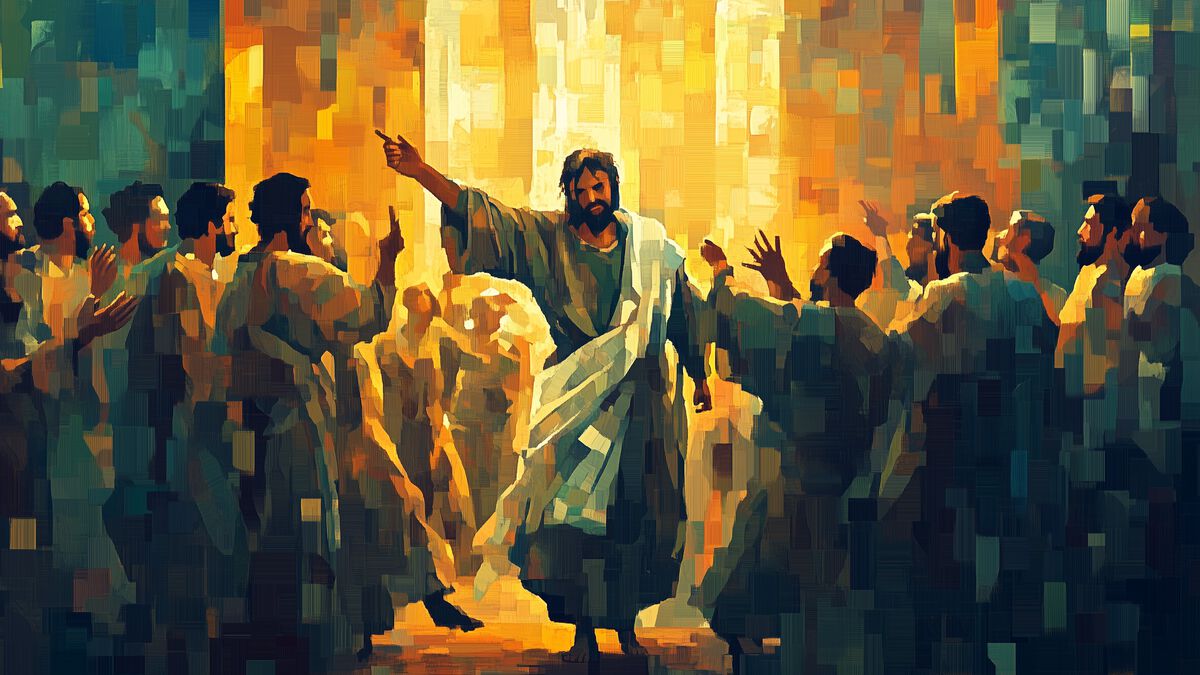
Christians purportedly look to Jesus as the principal example of the kind of person we should be. In some cases, however, we've clearly failed to read, understand or internalize the descriptions of Jesus in the New Testament. So, instead of comforting those who mourn, some of us heckle those who mourn. Instead of being merciful, some of us are merciless. Instead of making peace, some of us try to insult everyone.
Aren't these Christians just defending the commandments of God? Aren't they just following Jesus' example? No. Actually, they're not, if the New Testament is any indicator. Jesus generally doesn't act anything like some of the poorly behaving Christians of our day. "Thou shalt have no other gods before me," but Jesus observes that a pagan has greater faith than any of his own religion (Luke 7: 2-9). "Remember the sabbath day, to keep it holy," but Jesus is more concerned with his disciples' hunger (Mark 2: 23-28). "Honour thy father and thy mother," but Jesus celebrates the prodigal son (Luke 15: 11-24). "Thou shalt not kill," but Jesus does not protest the release of Barabbas (Mark 15: 6-11). "Thou shalt not commit adultery," but Jesus protects the adulterous woman (John 8: 3-11). "Thou shalt not steal," but Jesus is kind to the robbers crucified with him (Luke 23: 39-43). "Thou shalt not bear false witness," but Jesus counsels his disciples to deny knowing him (Mark 14: 27-30). "Thou shalt not covet," but Jesus gently invites the rich young man to change (Mark 10: 17-23).
There is, however, one exception. It's a great big obvious exception that no one should overlook, yet somehow some of us do. While the New Testament depicts Jesus as almost universally patient toward transgressors of the law, the text also depicts him as highly impatient, even to the point of violence, toward persons that exhibit one particular vice: religious arrogance and the associated abuse of ecclesiastical power. Read again, or for the first time, Jesus' criticism of the empowered religious elite of his day . . .
Matthew 23
1 Then spake Jesus to the multitude, and to his disciples,
2 Saying, The scribes and the Pharisees sit in Moses’ seat:
3 All therefore whatsoever they bid you observe, that observe and do; but do not ye after their works: for they say, and do not.
4 For they bind heavy burdens and grievous to be borne, and lay them on men’s shoulders; but they themselves will not move them with one of their fingers.
5 But all their works they do for to be seen of men: they make broad their phylacteries, and enlarge the borders of their garments,
6 And love the uppermost rooms at feasts, and the chief seats in the synagogues,
7 And greetings in the markets, and to be called of men, Rabbi, Rabbi.
8 But be not ye called Rabbi: for one is your Master, even Christ; and all ye are brethren.
9 And call no man your father upon the earth: for one is your Father, which is in heaven.
10 Neither be ye called masters: for one is your Master, even Christ.
11 But he that is greatest among you shall be your servant.
12 And whosoever shall exalt himself shall be abased; and he that shall humble himself shall be exalted.
13 But woe unto you, scribes and Pharisees, hypocrites! for ye shut up the kingdom of heaven against men: for ye neither go in yourselves, neither suffer ye them that are entering to go in.
14 Woe unto you, scribes and Pharisees, hypocrites! for ye devour widows’ houses, and for a pretence make long prayer: therefore ye shall receive the greater damnation.
15 Woe unto you, scribes and Pharisees, hypocrites! for ye compass sea and land to make one proselyte, and when he is made, ye make him twofold more the child of hell than yourselves.
16 Woe unto you, ye blind guides, which say, Whosoever shall swear by the temple, it is nothing; but whosoever shall swear by the gold of the temple, he is a debtor!
17 Ye fools and blind: for whether is greater, the gold, or the temple that sanctifieth the gold?
18 And, Whosoever shall swear by the altar, it is nothing; but whosoever sweareth by the gift that is upon it, he is guilty.
19 Ye fools and blind: for whether is greater, the gift, or the altar that sanctifieth the gift?
20 Whoso therefore shall swear by the altar, sweareth by it, and by all things thereon.
21 And whoso shall swear by the temple, sweareth by it, and by him that dwelleth therein.
22 And he that shall swear by heaven, sweareth by the throne of God, and by him that sitteth thereon.
23 Woe unto you, scribes and Pharisees, hypocrites! for ye pay tithe of mint and anise and cummin, and have omitted the weightier matters of the law, judgment, mercy, and faith: these ought ye to have done, and not to leave the other undone.
24 Ye blind guides, which strain at a gnat, and swallow a camel.
25 Woe unto you, scribes and Pharisees, hypocrites! for ye make clean the outside of the cup and of the platter, but within they are full of extortion and excess.
26 Thou blind Pharisee, cleanse first that which is within the cup and platter, that the outside of them may be clean also.
27 Woe unto you, scribes and Pharisees, hypocrites! for ye are like unto whited sepulchres, which indeed appear beautiful outward, but are within full of dead men’s bones, and of all uncleanness.
28 Even so ye also outwardly appear righteous unto men, but within ye are full of hypocrisy and iniquity.
29 Woe unto you, scribes and Pharisees, hypocrites! because ye build the tombs of the prophets, and garnish the sepulchres of the righteous,
30 And say, If we had been in the days of our fathers, we would not have been partakers with them in the blood of the prophets.
31 Wherefore ye be witnesses unto yourselves, that ye are the children of them which killed the prophets.
32 Fill ye up then the measure of your fathers.
33 Ye serpents, ye generation of vipers, how can ye escape the damnation of hell?
Fellow Christians, are we following Jesus' example? In word only or also in deed? Are we interpreting our religion in ways that create psychological and social burdens for our fellows, or are we relieving such burdens? Is our religiosity a show for egotistical political gain, or does it actually reflect a liberal charity? Do we seek to raise ourselves above others, or do we seek each other to rise together? Do we preach a God of oppression or love? Do we care more for money than the virtues that make possible its value? Do we care more for scriptural syntax than for the spirit of God? Can we still feel the forth-telling of a prophet?
"Look!" and Live: Meditation on 3 Nephi 28
by
Lincoln Cannon
at
1/06/2011 03:44:00 AM
I wrote a short fictional/exegetical article entitled "'Look!' and Live: Meditation on 3 Nephi 28" for the December 2010 issue of Sunstone Magazine. Before sharing the text of the article, I'd like to share some thoughts that complement the article.
3 Nephi 28 is particularly interesting to Mormons with Transhumanist inclination because it provides religious justification for pursuit of radical life extension. Consider the difference between the nine disciples that are "blessed" and the three disciples that are "more blessed". All twelve aspire to persistent Christian discipleship, so that is not the difference. The difference is that the three disciples desire persistent discipleship in THIS life, indefinitely without dying.
Consider also what Jesus does NOT touch in 3 Nephi 28: 12. He touches each of the nine disciples, but none of the three. Instead, the three are "caught up into heaven" and transfigured. Jesus doesn't personally do everything. The prophecies are that everyone shall hear the gospel of Christ and everyone shall be transfigured or resurrected to glorified bodies, but the prophecies are NOT that Jesus will directly do all the work. Rather, we are called to participate according to our abilities.
Finally, consider the emotional message of the passage. The three are worried about what others might think of their desire, to the point of hesitating to share it. Yet, in the end, they gain the greater approval. Neither Mormons nor Transhumanists are particularly popular, even with each other. From some secular perspectives, Mormons have all the baggage of Christian superstition plus some extra crazy stuff, and Transhumanists are pseudo-religious nut jobs. From some religious perspectives, Mormons are apostate heretics and Transhumanists are harbingers of the apocalypse. Yet what if trust in our ability to achieve radical life extension is essential to realizing it? In that day, those who were once stumblingblocks and fools may gain the greater approval.
Here's the text of my article. Please share your thoughts in the comments. Thank you.
"Look!" and Live: Meditation on 3 Nephi 28
"What do you want after I'm gone?"
Zed swallowed. He had expected the question, but still was not ready. No one answered. The question echoed in the silence. Which of you, if your child asks for bread, will give a stone? If asked for fish, will you give a snake? Ask and you'll receive.
The questioner reached out. Zed tilted his head slightly and raised an eye to see just past the head in front of him to where the questioner's hand rested briefly on another. They spoke quietly. Zed couldn't hear. The questioner touched another and another, as they spoke. Zed strained to listen, watching sincere wishes flicker across faces. The questioner turned, and Zed returned behind the head. Heart racing, he silently rehearsed familiar words. They are delivered from that awful monster, death. If I die in the dark, it'll be because I don't ask.
"What do you want after I'm gone?"
Zed heard the question repeated faintly, and soon again less faintly. Closing his eyes, he thought he could make out others' words, asking for reunion and rest, and the questioner's response, "You're blessed."
"Zed, what do you want me to do to you when I'm gone?"
He shuddered. My wish is a sin. I should be content with my allotment. We must die.
"Look!"
He dared not move, but essayed a peek at the ground. The feet of the questioner were near. If I touch even his clothes! The grace, justice, power and mercy of deliverance from death.
"I know your thoughts."
His face burned.
"You want what John, who I love, asked of me."
Zed started. Carefully, his head was raising. Tentatively, his eyes were meeting the questioner. As many as look with trust will live.
"So you're more blessed, because you'll never die."
Zed was touched, not by the questioner, but by a friend at his side. The questioner continued to speak. Zed was touched again, by another friend. The questioner concluded and turned away. Zed almost reached out, but realized he was not alone. They were no longer ashamed, and they lived.
3 Nephi 28 is particularly interesting to Mormons with Transhumanist inclination because it provides religious justification for pursuit of radical life extension. Consider the difference between the nine disciples that are "blessed" and the three disciples that are "more blessed". All twelve aspire to persistent Christian discipleship, so that is not the difference. The difference is that the three disciples desire persistent discipleship in THIS life, indefinitely without dying.
Consider also what Jesus does NOT touch in 3 Nephi 28: 12. He touches each of the nine disciples, but none of the three. Instead, the three are "caught up into heaven" and transfigured. Jesus doesn't personally do everything. The prophecies are that everyone shall hear the gospel of Christ and everyone shall be transfigured or resurrected to glorified bodies, but the prophecies are NOT that Jesus will directly do all the work. Rather, we are called to participate according to our abilities.
Finally, consider the emotional message of the passage. The three are worried about what others might think of their desire, to the point of hesitating to share it. Yet, in the end, they gain the greater approval. Neither Mormons nor Transhumanists are particularly popular, even with each other. From some secular perspectives, Mormons have all the baggage of Christian superstition plus some extra crazy stuff, and Transhumanists are pseudo-religious nut jobs. From some religious perspectives, Mormons are apostate heretics and Transhumanists are harbingers of the apocalypse. Yet what if trust in our ability to achieve radical life extension is essential to realizing it? In that day, those who were once stumblingblocks and fools may gain the greater approval.
Here's the text of my article. Please share your thoughts in the comments. Thank you.
"Look!" and Live: Meditation on 3 Nephi 28
"What do you want after I'm gone?"
Zed swallowed. He had expected the question, but still was not ready. No one answered. The question echoed in the silence. Which of you, if your child asks for bread, will give a stone? If asked for fish, will you give a snake? Ask and you'll receive.
The questioner reached out. Zed tilted his head slightly and raised an eye to see just past the head in front of him to where the questioner's hand rested briefly on another. They spoke quietly. Zed couldn't hear. The questioner touched another and another, as they spoke. Zed strained to listen, watching sincere wishes flicker across faces. The questioner turned, and Zed returned behind the head. Heart racing, he silently rehearsed familiar words. They are delivered from that awful monster, death. If I die in the dark, it'll be because I don't ask.
"What do you want after I'm gone?"
Zed heard the question repeated faintly, and soon again less faintly. Closing his eyes, he thought he could make out others' words, asking for reunion and rest, and the questioner's response, "You're blessed."
"Zed, what do you want me to do to you when I'm gone?"
He shuddered. My wish is a sin. I should be content with my allotment. We must die.
"Look!"
He dared not move, but essayed a peek at the ground. The feet of the questioner were near. If I touch even his clothes! The grace, justice, power and mercy of deliverance from death.
"I know your thoughts."
His face burned.
"You want what John, who I love, asked of me."
Zed started. Carefully, his head was raising. Tentatively, his eyes were meeting the questioner. As many as look with trust will live.
"So you're more blessed, because you'll never die."
Zed was touched, not by the questioner, but by a friend at his side. The questioner continued to speak. Zed was touched again, by another friend. The questioner concluded and turned away. Zed almost reached out, but realized he was not alone. They were no longer ashamed, and they lived.
Subscribe to:
Posts (Atom)