Loading

Turn Back the Doomsday Clock

The Doomsday Clock has moved a minute closer to midnight. It's managed by the Bulletin of the Atomic Scientists, who have since 1947 used the clock to communicate their assessment of the degree of global catastrophic risk facing humanity.

Humanity faces a broad set of extinction risks, both natural and artificial. While it seems obvious to many of us that it's in our interest, both practically and morally, to seek to understand and mitigate these risks, some of us ignore or actively marginalize efforts to call attention to them. Such resistance is particularly common among conservative groups, sometimes driven by religious expectations that God will save us from these problems, regardless of our efforts. I hope my fellow Mormons will increasingly recognize that our religious texts clearly reject such passivity, as exemplified by Alma 60 in the Book of Mormon:

"And now, my beloved brethren — for ye ought to be beloved; yea, and ye ought to have stirred yourselves more diligently for the welfare and the freedom of this people; but behold, ye have neglected them insomuch that the blood of thousands shall come upon your heads for vengeance; yea, for known unto God were all their cries, and all their sufferings — Behold, could ye suppose that ye could sit upon your thrones, and because of the exceeding goodness of God ye could do nothing and he would deliver you? Behold, if ye have supposed this ye have supposed in vain. Do ye suppose that, because so many of your brethren have been killed it is because of their wickedness? I say unto you, if ye have supposed this ye have supposed in vain; for I say unto you, there are many who have fallen by the sword; and behold it is to your condemnation; For the Lord suffereth the righteous to be slain that his justice and judgment may come upon the wicked; therefore ye need not suppose that the righteous are lost because they are slain; but behold, they do enter into the rest of the Lord their God . . . Have ye forgotten the commandments of the Lord your God? Yea, have ye forgotten the captivity of our fathers? Have ye forgotten the many times we have been delivered out of the hands of our enemies? Or do ye suppose that the Lord will still deliver us, while we sit upon our thrones and do not make use of the means which the Lord has provided for us? Yea, will ye sit in idleness while ye are surrounded with thousands of those, yea, and tens of thousands, who do also sit in idleness, while there are thousands round about in the borders of the land who are falling by the sword, yea, wounded and bleeding? Do ye suppose that God will look upon you as guiltless while ye sit still and behold these things? Behold I say unto you, Nay. Now I would that ye should remember that God has said that the inward vessel shall be cleansed first, and then shall the outer vessel be cleansed also."

Let's listen to the voices of warning. Let's understand the challenges presented to us by our environment and technology. And let's do what we must to make and preserve the better world to which we commonly aspire.

John 3: 16 from a Mormon Perspective

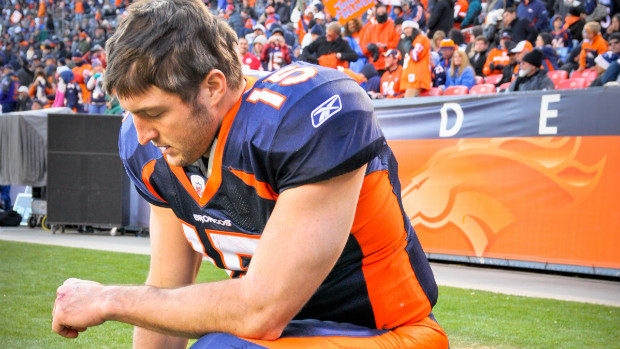
Sports news media and google searchers are presently giving the Biblical passage at John 3: 16 a lot of attention because Tim Tebow, an American football player known for advocating Christianity by displaying references to "John 3: 16", recently led the Denver Broncos to victory over the Pittsburgh Steelers by passing for 316 yards and averaging 31.6 yards per completion. Do you see it? "John 3: 16", "316 yards", and "31.6 yards per completion": the statistics would appear to point at Tim's favorite reference, as if by divine intervention.

Here's how the passage reads in the King James Version of the Bible: "For God so loved the world, that he gave his only begotten Son, that whosoever believeth in him should not perish, but have everlasting life." Many Christians, including some Mormons, interpret this passage to indicate a hard distinction between our own nature and capacity and that of Jesus. On the one hand, Jesus is the "only begotten Son" of God, whereas (the assumed implication goes) we're not begotten sons or daughters of God.

However, other passages of the Bible, particularly those that teach theosis, undermine such an interpretation, as do the teachings of many early Christian authorities on theosis. Of particular note is John 17: 22, where Jesus says, “I’ve given others the glory you gave me, that they may be one as we are one.” Here, Jesus invites us to participate in his glory, the glory of Christ, not partially, but together as one with him, making us all together the only begotten of God. In Mormon scripture, Doctrine and Covenants 76: 24 makes this even more explicit: "That by him, and through him, and of him, the worlds are and were created, and the inhabitants thereof are begotten sons and daughters unto God."

A common will and work of taking on the identity of Christ, serving and suffering for others, for the sake of a better world beyond present notions of suffering and death, is Jesus' central message, and essential to my Christian identity. We, together, should be that child of God, maturing to Godhood according to the nurturing grace afforded us.

Deification Banned "By Common Consent"

[3 January 2012 11:48pm - If I were to write this post again now, it would be titled and focused differently. As I've reviewed and discussed with others the posts and comments exchanged between BCC and me, and as I've considered subsequent claims by BCC, I've become persuaded that BCC chose to ban me more because of the timing and tone of my comments than because of their content. By this, I do not mean that I now agree with the ban. To the contrary, my surprise has only shifted, from an apparent ideological disagreement with BCC, to the hypocrisy of BCC employing ridicule and taunts while banning me for expressing an idea at a time and with a tone that "some folks didn't like". In any case, this post will remain in place, to document communication and clarification after the ban. Hopefully this note will resolve concerns that I misrepresented BCC before it communicated a reason for the ban.]

"By Common Consent" is a Mormon blog that has banned persons from affirming that faith in deification is essential to Mormonism. Fundamentalists rejoice! You've scared the Mormonism right out of some of us.

Today, a blogger at "By Common Consent", BHodges asks the question, "Did President Hinckley downplay deification?" BHodges' question refers to instances when the former president of the LDS Church, Gordon Hinckley, interviewed on national television and, according to critics, downplayed Mormon faith in deification. BHodges' analysis shows that Hinckley only appeared to downplay faith in deification because (a) Hinckley was actually acknowledging limited attention to God’s origins, and (b) Hinckley later affirmed faith in deification. The implied conclusion is that Hinckley did the right thing by not downplaying faith in deification. However, BHodges' analysis undermines its implied conclusion from the beginning by engaging in the very behavior that most often leads others to charge that Mormons downplay our faith in deification. Here are the first two sentences:

“‘Do Mormons believe they can become Gods’ is a question that requires much more than a yes or no answer, to be sure. If members of the Church are reluctant to answer with a simple 'yes' or 'no', they seem to be trying to hide something, or to be unversed on the subject.”

These introductory sentences downplay faith in deification. There's no affirmation, simple or nuanced. There's only noncommittal rhetoric that earns (while ironically acknowledging) the criticism it receives: charges of deception or ignorance. In this case, the charge should be ignorance, not in any doctrinal sense, but in an unintentional sense that arises from insufficient editing. To illustrate, here’s a simple edit that would decrease the likelihood that a reader would understand BHodges to be downplaying Mormon faith in deification:

“Do Mormons believe they can become Gods” is a question that often requires much more than a yes, to be sure. If members of the Church are reluctant to answer with a simple “yes”, they seem to be trying to hide something, or to be unversed on the subject.

When I read BHodges analysis, I agreed with it, but I didn't like how he introduced it. So I expressed my concern by affirming Mormon faith in deification and by challenging other self-identifying Mormons as follows:

"Do Mormons believe humans can and should become God? Yes. If you don’t then you’re about as Mormon as a fundamentalist or an atheist."

One of the blog regulars, J Stapley, expressed his disagreement, ironically, through repeated appeals to ridicule. When he finally got around to expressing his disagreement otherwise, it turned out he thought I would "excommunicate" self-identifying Mormons that don't affirm faith in deification. I explained that I'm not interested in excommunicating anyone. To the contrary, to avoid a vacuous "Mormonism" that means everything and nothing, and to avoid a dogmatic "Mormonism" that's too inflexible to survive, I'm interested in communicating positions and reasons among Mormons, perhaps most particularly when we don't like what each other has to say.

Another apparent regular, Ray, reminded everyone that I wasn't focusing on the main point of the analysis. He was right, of course, but there's also some irony here. The analysis would persuade us that Mormons don't downplay faith in deification, but the defenders of the analysis apparently don't want such faith affirmed!

Another, Sonny, wondered whether I had previously been banned from commenting on the blog because he didn't like my attitude. I hadn't been, but the comment made me wonder whether others had been banned for making comments like mine, so I requested that I be banned if that were the case. Within 90 minutes, Steve Evans confirmed by banning me, apparently thinking it funny.

With my fellows, banned "By Common Consent" from affirming our faith in deification, I wonder, "Are we still Gods in embryo?"