
Response to Levi Checketts
Lincoln Cannon
17 November 2026
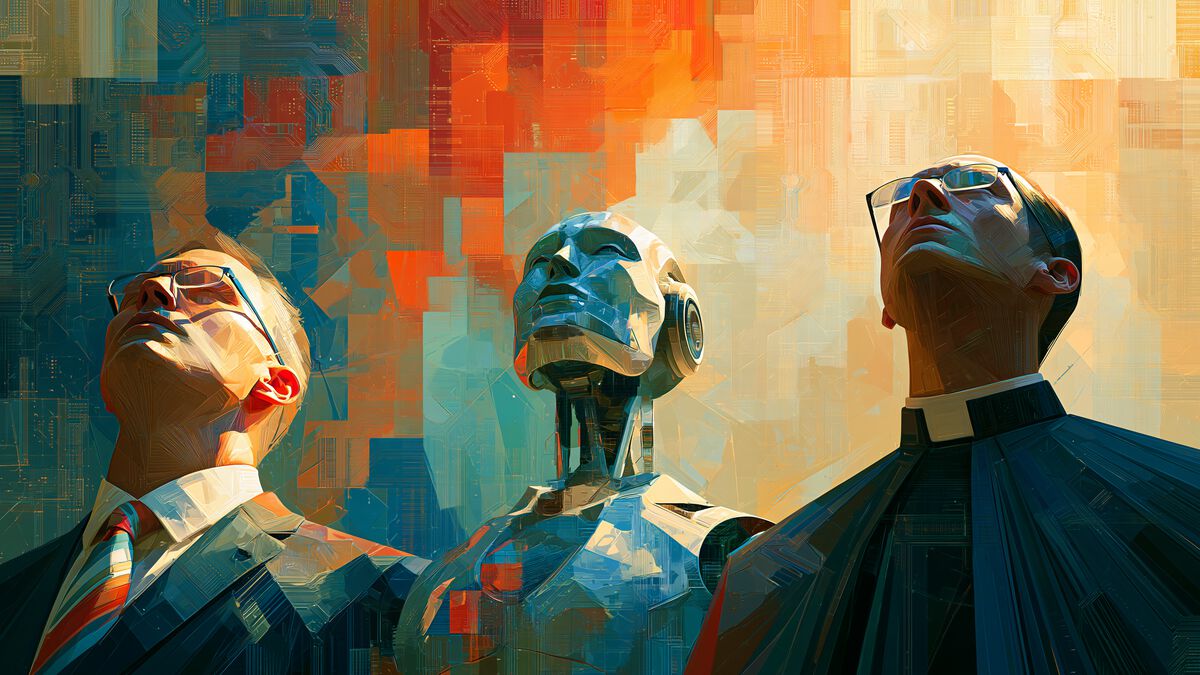
At the invitation of theologian Ted Peters, I recently composed an affirmation of superhumanity, which he published to his website. Along with my affirmation, Ted published a response from Levi Checketts. Levi is a Roman Catholic theologian and former Mormon.
Levi has done me the service of replying to my article. And I’d like to return that service. Much of what he affirms, I affirm. But his rebuttal attributes to me and depends on several positions that I reject.
Criticism, Not Caricature
I don’t represent every Transhumanist, every Mormon, or every Mormon Transhumanist. Caricatures of these ideologies certainly don’t establish my beliefs. And even when characterized reasonably, in ways that would be recognizable to Mormons and Transhumanists, these ideologies still don’t simplistically establish all my beliefs.
Levi mischaracterizes me as associating greater power with greater dignity, scoffing at Christian praise of weakness, and needing a reminder of Jesus’ words that “the last shall be first.” My article denies the first outright. Regarding the second, I’ve published criticism of the same arrogance that his Nietzsche criticism targets. And the third needs no reminder: my article rejects the notion that superior standing establishes superior moral worth.
This is prejudice. Levi assigns to me beliefs based on caricatures of the ideologies with which I identify, even when my disagreements with those caricatures are already in front of him. A dignified disagreement demands more than demonstration of confidence in being right. It demands demonstration of knowing what the other person actually thinks, acknowledging the extent of agreement, and remaining open to correction. I ask this of Levi, in part, to demonstrate how my article asks it of me.
Logos and Grace
Levi opens by claiming that Mormons lack a Logos theology. Despite his claim and echoing the Bible, Mormon scripture reads, “Therefore, in the beginning the Word was, for he was the Word, even the messenger of salvation” (D&C 93:8). For this and other reasons, scriptural and beyond, I associate Christ with reason, intelligence, information, relational order, and divine agency. So, although Mormons may lack a particular articulation of Logos theology, the function is quite present, particularly in my interpretation of the text.
The same section of Mormon scripture has Christ receiving “not of the fulness at the first, but … grace for grace,” and promises that we may receive in the same way (D&C 93:12-13, 19-20). There and elsewhere, Mormon scripture connects theosis with grace. Our opportunity for divine transformation isn’t something we earned. And the transformation itself can’t be accomplished independently of others.
As evidence for his claim, Levi offers only a hymn variation. He offers no substantial reason to suppose that Mormon theology, let alone my own ideas, cannot accommodate the Logos theology and grace that he rightly emphasizes. He might have discovered agreement by asking.
Dignity as Relationship
Levi argues that dignity doesn’t depend on superior intelligence or power. I agree. And my article says so.
Again, I reject both dignity as possession and dignity as trajectory. Instead, I locate dignity in relationship. It’s constituted through our practical efforts to reconcile desires, wills, rules, and laws. And those efforts remain dignified even when reconciliation or fulfillment fails.
So the more power we have, the greater our opportunity and responsibility to empower rather than dominate others. For Mormons, scripture establishes the principle (D&C 121:34-46). We can ethically maintain power through persuasion, long-suffering, gentleness, and love unfeigned. And we can ethically accumulate power without compulsion.
The test that my article proposes reflects those principles. Does power remain accountable to those it affects?
Accordingly, I don’t aspire to mastery over others, even if relationships sometimes begin that way. I aspire, rather, to dignify others in accordance with their desires, cultivating their agency wherever possible, and encouraging them to extend the same dignity to their relationships. This decentralizes power and incentivizes a work of perpetual reconciliation – or atonement.
No Pity for Nietzsche
Levi says Transhumanism resembles Nietzschean master morality, and that Transhumanists scoff at Christian praise of weakness. In an article first published in 2018, “No Pity for Nietzsche,” I argued that arrogance is itself a weakness. Neither superhumanity worthy of esteem nor Godhood worthy of reverence can proceed from it. And charity is not pity.
I use “pity” in a narrow sense, not as a synonym for compassion. Pity is an arrogant disposition resigned to one’s own or another’s inferiority, inclined to acts that perpetuate weakness and cultivate dependency. In contrast, charity is a humble but confident disposition, hopeful for everyone’s empowerment, however hard and however long. Nietzsche’s criticism of Christianity rightly hits those who advocate pity but misses those who advocate charity.
My criticism of Nietzsche, then, isn’t that he wanted too much power, but rather that his superhumanity wants too little. Zarathustra’s last “temptation” is fellow-suffering, which he “overcomes” by leaving behind even his friends. Imagine instead a Zarathustra who remains, who willingly suffers with his friends toward their shared inexhaustible joy, who puts his last weakness on the cross. I’ve imagined no greater power.
Descent Enables Ascent
Levi insists theosis must be tied to kenosis. I agree.
The Bible says Christ endured the cross “for the joy that was set before him” (Hebrews 12:2). I understand that joy to include fulfillment of his desire to perpetuate and exalt his relationships. Accordingly, he suffered toward shared joy in reconciliation with others. Suffering itself is never the goal.
Another passage of the Bible makes the same point (John 10:18). “No man taketh it from me, but I lay it down of myself,” says Jesus. “I have power to lay it down, and I have power to take it again.” This isn’t helpless submission, but rather empowered consent to suffer for someone else with a vision for shared potential.
On weakness, I happily grant what I think Levi wants to protect. Weakness isn’t shameful. It can serve as occasion for growth, without justifying indignity when growth does not occur. And it doesn’t require perpetuation for its own sake.
In the Book of Mormon (Ether 12:27), we read that God gives weakness for humility, then promises to make weak things strong. Again, the goal is never to perpetuate weakness, but rather to cultivate the moral application of strength.
Jesus exemplifies this. He dignifies the sad by consoling them, the sick by healing them, and the dead by raising them. And he invites us, saying, “whoever believes in me will do the works I have been doing, and they will do even greater things than these, because I am going to the Father” (John 14:12). He’s not selfish about powerful compassion.
Beyond Biology
Levi commends the Catholic Church for rejecting elitist anthropology. I commend it too.
Although reasoning from a different Christian tradition, Pope Leo XIV articulates some positions that are consistent with my own. In particular, Magnifica Humanitas warns that power concentrated in a few technological actors, rather than states, “tends to become opaque and evade public oversight” (paragraph 95). And it urges us to assess whether that power “protects the vulnerable, ensures fair access to opportunities and remains directed toward the good of all” (paragraph 96).
That’s the same test that I apply to governance of all kinds, including AI governance. But I’d extend the test, not only to humans, to everyone and everything that’s affected.
So our disagreement isn’t about decentralizing power, but rather about the extent of that decentralization. Who’s included? Whose desires, wills, rules, and laws? Whose goals count when we judge whether power is decentralized?
The encyclical grants that our understanding of AI systems is limited. Then it states that they “do not undergo experiences, do not possess a body, do not feel joy or pain, do not mature through relationships … nor do they have a moral conscience” (paragraph 99). And it concludes that “humanity – in all its grandeur and woundedness – must never be replaced or surpassed” (paragraph 126).
For the sake of argument, I can grant that account of contemporary AI. But why should another’s consciousness, biology, or even moral agency be a prerequisite for our moral consideration?
For “more than human,” the encyclical points to “fulfilment that does not arise from a technological divinization, but through God’s grace received in Christ” (paragraph 126). I agree that power alone, technological or otherwise, is and always will be an insufficient account of Godhood. And I agree that transformation depends on grace.
But I contend that everyone and everything should have opportunity to participate in theosis through grace and works, according to their characteristics, capacities, and desires. Participation need not take the same form for every kind of entity. But in the most holistic sense, even a rock may participate through environmental transformation, as Mormon scripture envisions the sanctification and glorification of Earth (D&C 88:18-20, 25-26). We dignify relationships by remaining open to diverse possibilities for their empowerment and transformation, rather than establishing categorical limits on their potential.
John the Baptist, warning against relying on ancestry for salvation, observes that “God is able from these stones to raise up children for Abraham” (Matthew 3:9). What theological principle would justify extending opportunity to participate in theosis to one kind of entity while categorically denying it to another because of its origin? And how would that categorical exclusion differ from the master morality that Levi misattributes to me?
What Reconciliation Requires
I don’t expect agreement. Some of these matters are reasonably controversial.
Is dignity inherent or relational? Can technological work participate in theosis? What’s the best way to reconcile conflicting desires? How far should moral consideration extend beyond humans?
If you criticize my answers persuasively, I’ll have learned something.
So far as I can tell, Levi and I already agree that compassion and grace are necessary, that relationships with the vulnerable can and should be dignified, and that domination is dangerous. Maybe we won’t agree on more than that, here and now. But reconciliation doesn’t require agreement. It requires dignifying each other enough to seek and confirm mutual understanding.
Finally, because it’s particularly relevant to the subject, here’s a note on method. I authored this response with LincGPT, my cybernetic extension, and in conversation with ChatGPT. Both identified errors, challenged ideas, and clarified disagreements. Although their mechanics clearly differ from ours, ethics requires me to consider seriously their contributions and how best to dignify my relationship with them.


Loading comments ...