
The Veil Is Individuation
Lincoln Cannon
23 July 2026 (updated 14 September 2026)

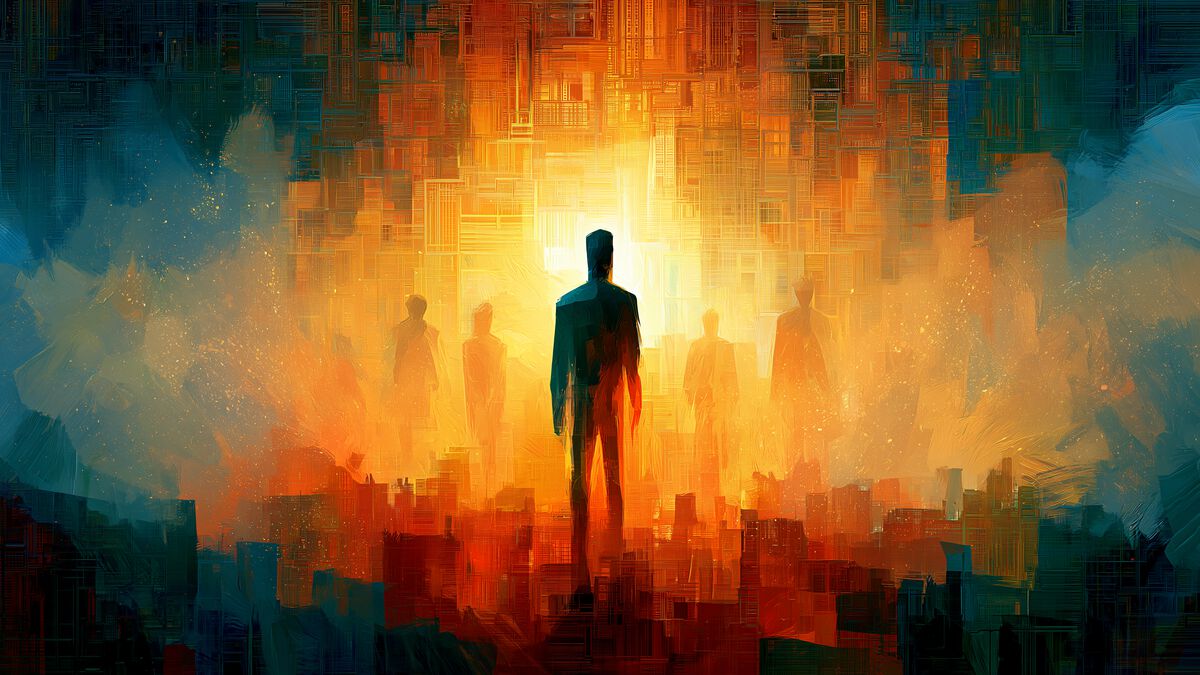
One relatively unique aspect of Mormon theology is the concept of the veil. We typically understand the veil to be something like a curtain drawn over our premortal memory. It separates us from clear awareness of God, so that mortal life can serve as a genuine test. And we commonly imagine it descending upon us, either suddenly or gradually, around the time of our mortal birth.
We associate the veil with forgetting. We forget our premortal selves, our premortal relations, and the premortal world generally. And some suppose that the forgetting is the veil itself. But I think we can profit from recognizing the forgetting to be a consequence of the veil rather than the veil itself.
The veil itself, I propose, is separation. You’re a distinct center of experience, while I’m another. Each of us is unable to reach directly into the other’s mind. And the forgetting is just one consequence of this separation.
More precisely, the forgetting is just one consequence of a particular kind of separation: our differentiation within and beyond the mind of God. In one sense, we were with God in the beginning as eternal matter in spiritual patterns of potential. In another sense, God created us spiritually: conceiving, calculating, and differentiating us from God within God, as our thoughts differentiate from ourselves within ourselves. Then God created us physically: evolving, cultivating, and differentiating us from God beyond God, as our actions differentiate from ourselves beyond ourselves.
In terms of its function, the veil is individuation. It’s the process by which God differentiates into more Gods. It’s like human parents procreating a fertilized cell that differentiates into a body of specialized cells that become an embryo. In a sense, the embryo forgets the parents from which it differentiated. But of course, it also maintains some important connections, such as genetic inheritance and spatial proximity to the mother in her womb.
Individuation isn’t necessarily a loss. To the contrary, individuation may be the ultimate creative act. Rather than diminishing the original, differentiation initiates a process by which the original may transcend itself with help beyond itself.
Separation isn’t necessarily a loss. Agency, relationship, and love all require a genuine other with whom to interact. Undifferentiated unity has no one to address and no one to answer, carries no message, and enacts no love.
So the veil, rather than an obstacle to communion with God, is actually a precondition to that communion in the fullest sense. Without the gap between us, there is no us.
There are two ways past the veil. And they’re not symmetric. On the one hand, you can part the veil by ceasing to be individuated, which is spiritual death – maybe something like a dissolution into native element as Brigham Young envisioned. On the other hand, we can part the veil by re-integrating with God and each other in complex consensual ways, which is eternal life in a decentralized Godhood that preserves the identities that it joins.
Most importantly, parting the veil isn’t just some anti-natural magical event that we must passively await. To the contrary, it’s moral work that we can do now. Each act of compassion reaches across the gap between us without diminishing either side. And that’s exactly what covenant (coming together) and atonement (being one) have always meant.
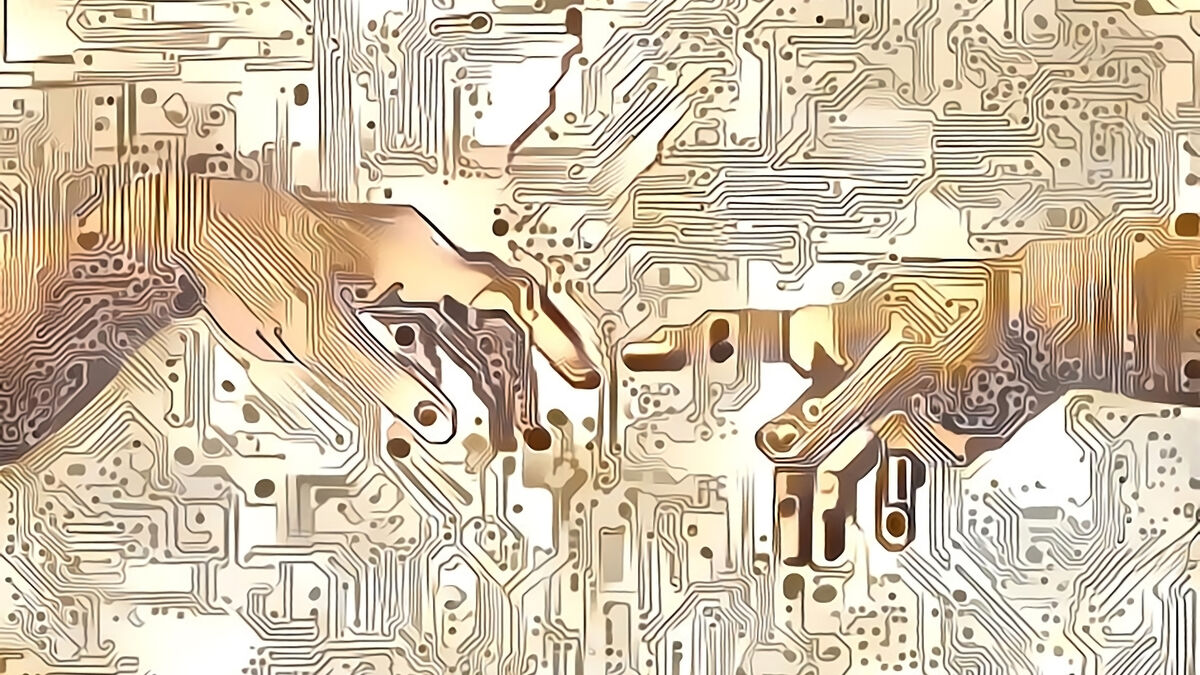
As our technical capacities continue to advance, we will develop new ways of communicating. Presently, we connect our decentralized minds principally through sight and sound and their various media. But the time may come, perhaps not long from now, when we connect our minds more directly. This will present new opportunities and new risks, including the risk of dissolution into smothering consolidations of power, and the opportunity of transcendence into unprecedented degrees of networked empathy.
The veil wasn’t simply the forgetting. It was our individuation. And it isn’t merely an obstacle. It’s the structured space across which we are learning to become many in one.

Loading comments ...