
Postsecular Christian Transhumanism
Lincoln Cannon
19 March 2026 (updated 28 September 2026)
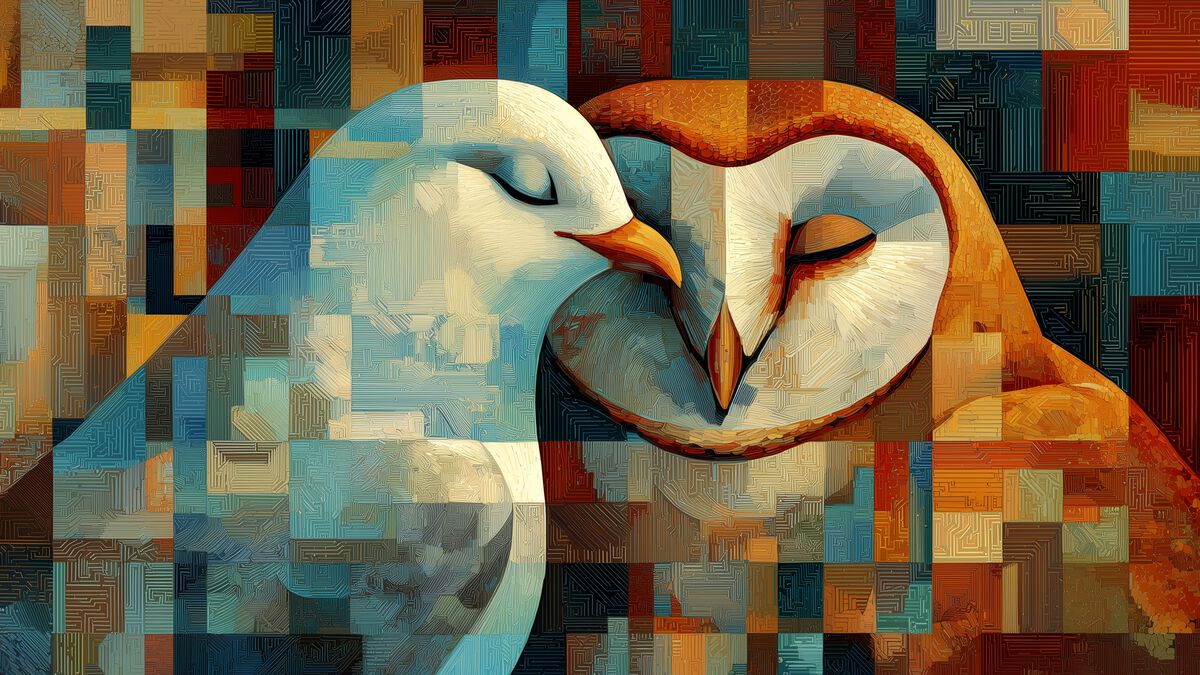
A Comment Magazine article, “Which Future Do We Want?”, presents its perspective on three competing visions of humanity’s future: anti-humanism, Transhumanism, and Posthumanism. It then positions “Christian humanism” as the corrective to all three. But it mistakes a conservative pit stop for the destination. And it mischaracterizes the tradition most capable of bridging the tensions it identifies.
Caricature of Transhumanism
The article presents Transhumanism as a desire to escape creaturely dependence. This is common, but reductive. Transhumanism is the ethical use of technology to enhance human abilities. If you think technology can and should enhance human abilities, while being concerned with the ethics, you’re a functional Transhumanist, whether or not you apply the label to yourself.
The deepest problem with the article is what it leaves out. Transhumanism is as ancient as theosis, the idea that humanity can and should become like God, which may be as ancient as religion itself. In Christianity, theosis isn’t peripheral. It’s a central doctrine, interpreted variously in Orthodox, Catholic, and Mormon theology.
When the article warns against “the desire to be like gods,” it unwittingly warns against the scriptural mandate, with countless examples. Paul tells the Romans they can inherit the glory of God with Christ. Peter encourages us to become partakers of divine nature. And, perhaps most notably, Jesus tells his disciples to do the same works he does, and even greater works.
The future, as envisioned by Christianity, isn’t a modest static humanism. Rather, it’s a perpetual participatory transformation into that which is superhuman. It’s functional Transhumanism, even if many Christians seem incapable of recognizing that.
The emergence of Transhumanism may have been a cultural consequence of Christianity’s increasingly timid advocacy of theosis. God always finds a way. If Christians won’t proclaim the full implications of our own theology, the inspiration can move, even donning lab coats instead of traditional frocks. Then, of course, some Christians complain about it.
Naturalism
The article portrays Transhumanism as a rejection of embodiment. But only the least educated Transhumanists fail to recognize that all minds have bodies, which are the substrates that shape and empower those minds. Minds (like spirits in Christianity) may be substrate independent in any specific sense (like death in Christianity), with capacity to move from less to more robust substrate (like resurrection in Christianity). But that doesn’t make minds substrate independent in a general sense.
Like almost all Transhumanists, I’m a thorough naturalist. So far as I’m concerned, even God is natural. Yet that doesn’t somehow prevent me from experiencing and acknowledging that which is sublime – the holy. Rather, it grounds the sublime in the physical universe, the experientially and scientifically accessible universe, where it can actually do the work of transformation.
For theists, naturalism is simply consenting that God can teach us everything about creation through creation. Resurrection, transfiguration, and immortality need not be magical violations of physics. They can be natural possibilities, even practical aspirations, toward which increasingly intentional technological and spiritual evolution may converge.
Mormon eschatology facilitates recognition of strong naturalist parallels between Christian and Transhumanist views of the future. It envisions resurrected bodies of varying types and degrees of glory in worlds without end, including those of Gods with “power to organize elements,” as Brigham Young once put it. Other Christian traditions may not elaborate on the ideas of embodied resurrection and material theosis to such extents. But Mormonism inherits those ideas from Christianity.
Most ironically, the article’s “Christian humanism” would seem to treat our current biological limits, a strict Humanism in contrast to Transhumanism, as permanent features. If so, that’s a nominal “bioconservative” position that’s not what it supposes or presents itself to be. It’s actually the radical proposition that we should change human nature by making it static. But human nature never has been static, and can never meaningfully be static.
Compassion
The article rightly insists on relationality and communion. I heartily agree, advocating nothing short of superhuman communion. And it’s precisely this relationality that requires us to work, both to decrease suffering and to increase thriving.
As expressed in the New God Argument, if we trust in our own superhuman potential, as Transhumanists do, then we should also trust that superhumanity probably would be more compassionate than we are. Our rapidly increasing power will probably destroy us unless we increasingly decentralize that power and cooperate in its applications. And such behavior, at its limit, becomes practically indistinguishable from compassion. In other words, coherent Transhumanism requires a practical working trust that we can scale compassion with capability.
This is the opposite of the escapism with which the article charges Transhumanism. It’s a call to hard work of all sorts. And it’s particularly a call to the hard work of relationality, even what Christians might recognize as communion or a participatory atonement that would take on Christ as exemplified and invited by Jesus. I can choose to forgive you, lighten your burden, and work with you to make a better world.
Postsecularism
The article offers a choice between four futures, as though they were mutually exclusive. I propose a fifth.
Postsecularism acknowledges both the value of religion and the categories of secularism. And it’s interested in undermining one or the other only to the extent that either is dogmatic. It takes science seriously without reducing everything to science. And it takes religion seriously without calcifying into fundamentalism.
Without rejecting science or religion, we can recognize that the sublime esthetic, that Holy Spirit, is the engine of human transformation. This sense of awe, beauty, and purpose precedes and motivates both science and ethics. And when we work to fill ourselves with it, the sublime esthetic changes our thoughts, our words, and our actions, which change the world.
I can’t think of anything more worthy of our trust than the good news, the Gospel, that humanity can and should become sublimely intelligent, compassionate, and creative. In the language of Christianity, this is to become Christ, as exemplified and invited by Jesus. It reflects the grace of possibility that transcends anything we did or can do alone. And it necessitates courage, commitment, and work toward transformation into that which transcends us.
Which future do we want? As a question, that’s a good start but a bad stop. Here’s the next step. Do we have the courage and compassion to build that future?
Love superhumanity with all your heart, mind, and strength. And love others as you love yourself, not as being human but as becoming superhuman. These are the great commands. They summarize all religion.


Loading comments ...